
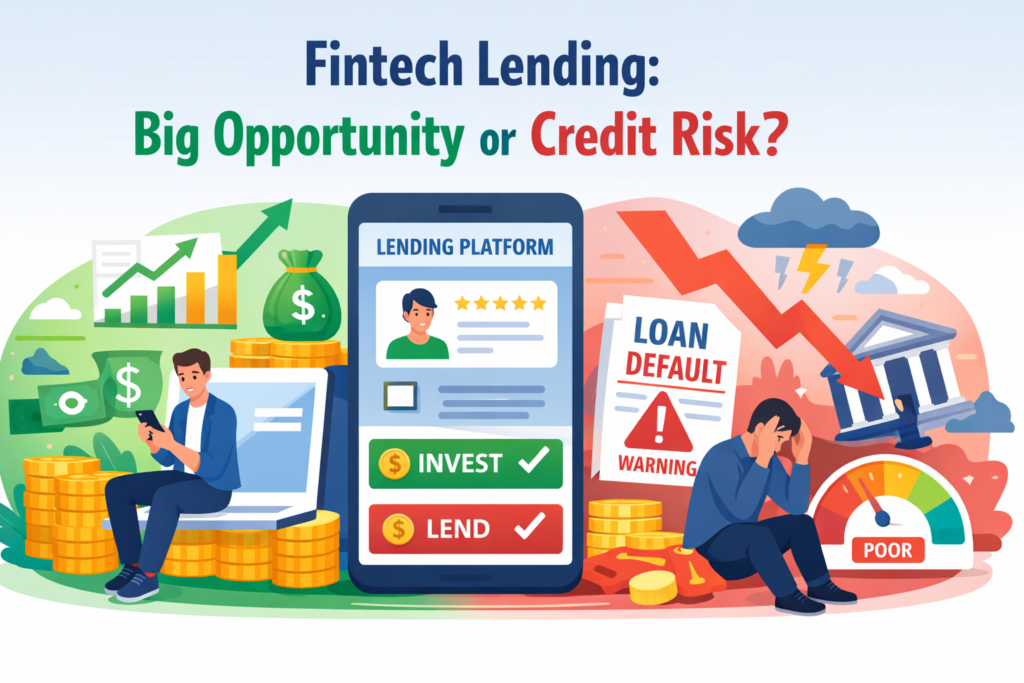
Over the past decade, financial technology—better known as fintech—has transformed nearly every corner of the financial industry. From digital payments and mobile banking to robo-advisors and blockchain systems, innovation has accelerated how people interact with money. Among the most disruptive segments within this ecosystem is fintech lending, often referred to as peer-to-peer (P2P) lending or digital lending platforms.
At first glance, fintech lending appears to be a revolutionary solution: faster approvals, easier access to credit, and attractive returns for investors. Yet beneath this rapid growth lies an important question that economists, regulators, and investors are beginning to ask: Is fintech lending a sustainable financial innovation—or the foundation of the next credit crisis?
This article explores the structure, opportunities, and risks of fintech lending, offering a deeper perspective on whether this booming sector represents a powerful investment opportunity or a potential systemic threat.
The Rise of Fintech Lending
Traditional banks have long dominated the lending market. However, banks operate within a heavily regulated framework and rely on complex internal processes for credit evaluation, compliance, and risk management. These systems often slow down the lending process and limit access for individuals who lack strong credit histories.
Fintech lending platforms emerged to challenge this traditional model.
By leveraging digital platforms, data analytics, and automated credit assessment, fintech companies can process loan applications much faster than traditional banks. In many cases, borrowers can receive approval within minutes and funding within hours or days—something that would typically take weeks through conventional banking channels.
Several key factors have driven the rapid expansion of fintech lending:
- Demand for faster credit access
- Underbanked populations lacking traditional credit access
- Advancements in data analytics and machine learning
- Investor demand for higher-yield alternative investments
As a result, fintech lending platforms have grown rapidly in markets around the world, including the United States, China, Europe, and Southeast Asia.
How Fintech Lending Platforms Work
Fintech lending platforms generally operate as intermediaries between borrowers and investors. Instead of using their own balance sheets to issue loans like banks do, many platforms connect individual borrowers with individual or institutional investors willing to fund those loans.
The typical fintech lending process follows several steps:
- Borrower Application
Borrowers submit loan requests through an online platform. Information may include income data, employment history, banking transactions, and other financial indicators. - Automated Risk Assessment
The platform uses algorithms and credit models to evaluate the borrower’s risk level. These models often analyze thousands of data points, including alternative data such as spending patterns or online behavior. - Loan Listing
Once approved, the loan request is listed on the platform for investors to fund. - Investor Participation
Investors can fund all or part of the loan, often spreading their capital across multiple borrowers to diversify risk. - Loan Repayment
Borrowers repay the loan over time with interest, and investors receive their share of the payments.
This structure allows fintech lending platforms to scale rapidly because they do not need the massive capital reserves required for traditional lending institutions.
Why Investors Are Attracted to Fintech Lending
Fintech lending has become particularly attractive to investors searching for higher returns than traditional financial instruments.
In many markets, savings accounts and government bonds offer relatively low yields. Meanwhile, fintech lending platforms often advertise returns that can range from 6% to 15% annually, depending on borrower risk levels.
For investors, several factors make this model appealing:
1. Higher Potential Returns
Compared with traditional fixed-income investments, fintech lending can offer significantly higher yields. For investors willing to accept higher risk, these platforms present an opportunity to generate strong passive income.
2. Portfolio Diversification
Fintech lending can serve as an alternative asset class, helping investors diversify beyond stocks, bonds, and real estate. By allocating a portion of their capital to digital lending, investors may reduce dependence on traditional market cycles.
3. Technology-Driven Efficiency
Because fintech lending platforms rely heavily on automation, operating costs can be lower than those of traditional banks. These savings can translate into better rates for both borrowers and investors.
4. Expanding Global Market
The global demand for credit remains enormous. Millions of small businesses and individuals lack access to traditional bank loans. Fintech lenders aim to fill this gap, creating an expanding market for digital credit services.
The Hidden Risks of Fintech Lending
Despite its promise, fintech lending also carries significant risks—many of which are not always obvious to inexperienced investors.
1. Credit Risk
The most obvious risk is borrower default. Many fintech lending platforms serve individuals who may not qualify for traditional bank loans, meaning the average borrower risk may be higher.
If economic conditions worsen, default rates could rise rapidly, potentially erasing investor returns.
2. Algorithmic Bias and Mispricing
Fintech companies rely heavily on algorithms to evaluate borrower risk. However, algorithms are only as reliable as the data and assumptions behind them.
If credit models underestimate risk—especially during periods of economic expansion—loan portfolios could become dangerously mispriced.
This has happened before in financial history, particularly during the 2008 global financial crisis, when flawed credit models contributed to widespread financial instability.
3. Liquidity Risk
Unlike stocks or bonds, loans on fintech platforms are often illiquid investments. Investors may not be able to quickly sell their positions if they need access to cash.
Some platforms offer secondary markets, but liquidity can be limited.
4. Platform Risk
Investors are also exposed to the financial health of the platform itself. If a fintech lending company fails due to poor management, fraud, or regulatory pressure, investors may face significant complications in recovering their funds.
5. Regulatory Uncertainty
Fintech lending operates in a rapidly evolving regulatory environment. Governments around the world are still determining how to oversee digital lending platforms.
Sudden regulatory changes can dramatically impact business models and profitability.
For example, stricter lending regulations could reduce loan volumes, while new compliance requirements could increase operational costs.
Lessons from Previous Fintech Lending Failures
The rapid growth of fintech lending has not been without setbacks. In some countries, especially during the early years of P2P lending expansion, hundreds of platforms collapsed due to poor governance and weak risk management.
One notable example occurred in China, where thousands of P2P lending platforms emerged in the early 2010s. Many promised high returns but lacked proper oversight.
When defaults increased and regulatory scrutiny intensified, a massive wave of platform closures followed, leaving many investors with substantial losses.
These events highlight the importance of strong regulation, transparency, and risk management within the fintech lending ecosystem.
The Role of Institutional Investors
Interestingly, fintech lending is no longer dominated solely by retail investors.
Large institutional investors—including hedge funds, asset managers, and even traditional banks—have increasingly entered the space. These institutions bring large pools of capital and sophisticated risk analysis capabilities.
Their participation has two major implications:
- Greater market legitimacy
- Increased competition for loan opportunities
However, institutional dominance could also reduce returns for smaller investors as competition drives down interest rates.
The Future of Fintech Lending
Despite the risks, fintech lending is unlikely to disappear. In fact, the sector will likely continue evolving as technology and regulation mature.
Several trends may shape the future of digital lending:
Artificial Intelligence Credit Models
Advanced AI systems may significantly improve credit risk evaluation, allowing lenders to better predict borrower behavior and reduce default rates.
Embedded Finance
Lending services may increasingly be integrated directly into non-financial platforms such as e-commerce marketplaces, ride-sharing apps, or digital ecosystems.
Stronger Regulation
Governments are likely to introduce clearer regulations to stabilize the industry and protect investors.
Collaboration with Traditional Banks
Rather than replacing banks entirely, fintech lenders may increasingly collaborate with financial institutions, combining technological efficiency with banking infrastructure.
Opportunity or Warning Signal?
Fintech lending represents one of the most fascinating developments in modern finance. On one hand, it offers the potential to democratize access to credit, support small businesses, and provide attractive returns for investors.
On the other hand, the rapid expansion of digital lending raises concerns about credit quality, regulatory oversight, and systemic financial risk.
For investors, the key lesson is clear: fintech lending should not be viewed as a risk-free income stream. Like any financial innovation, it carries both opportunities and dangers.
Understanding how these platforms operate, evaluating risk carefully, and diversifying investments remain essential strategies for anyone considering participation in the fintech lending market.
As technology continues to reshape the financial world, fintech lending will remain at the center of an ongoing debate: Is it a revolutionary step toward a more inclusive financial system—or the early stage of the next credit bubble?
The answer will likely depend not only on technology, but also on regulation, responsible innovation, and the ability of investors to balance opportunity with caution.