
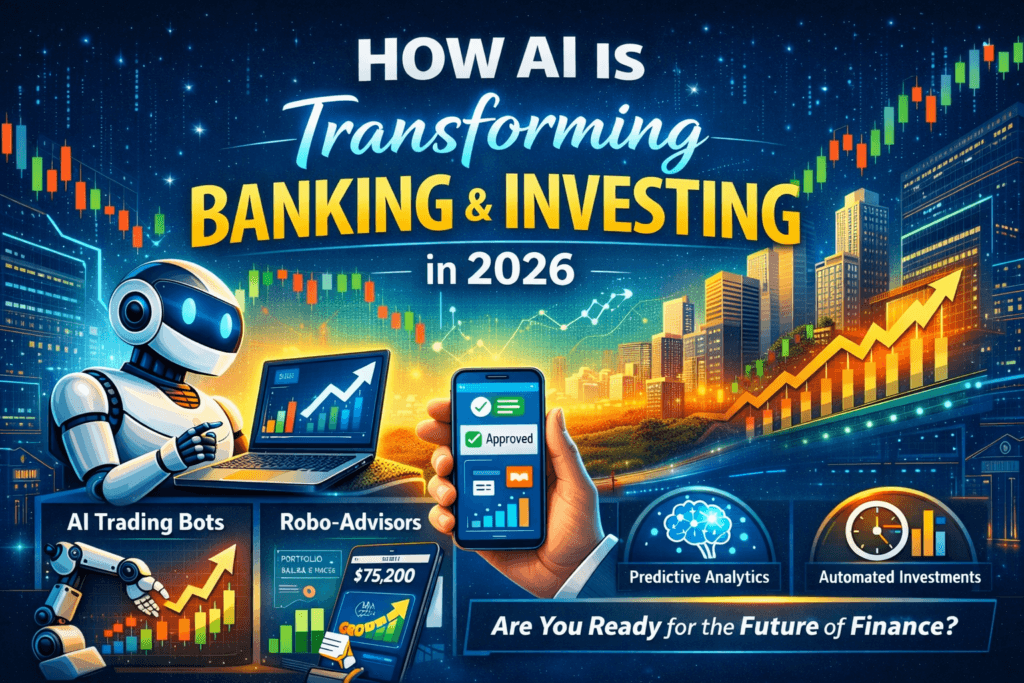
Artificial Intelligence is no longer a futuristic concept in finance — it is the operating system behind modern banking and investing. In 2026, AI is not just assisting financial institutions; it is reshaping how money is moved, invested, protected, and grown. Whether you are a retail investor, a bank customer, or a fintech founder, the transformation is already affecting your financial life.
AI in Banking: From Automation to Intelligence
Traditional banking used to rely heavily on manual review, paperwork, and delayed decision-making. Today, AI systems analyze millions of transactions in real time. Fraud detection algorithms flag suspicious activity within seconds. Credit scoring models evaluate borrowers using alternative data, making lending decisions faster and often more inclusive.
But the biggest shift is personalization. AI now studies customer behavior patterns to recommend financial products tailored to individual needs. Instead of generic offers, customers receive suggestions based on spending habits, savings behavior, and long-term goals. This level of customization increases engagement — and loyalty.
Chatbots have also evolved. In 2026, AI-driven virtual assistants handle complex queries, guide customers through mortgage applications, and even offer budgeting advice. They are available 24/7, reducing operational costs while improving user experience.
AI in Investing: Data Becomes Strategy
On the investing side, AI is transforming how decisions are made. Algorithms analyze earnings reports, macroeconomic indicators, social sentiment, and geopolitical events simultaneously. What once required a team of analysts can now be processed in milliseconds.
Retail investors benefit from robo-advisors powered by machine learning. These platforms build diversified portfolios, rebalance automatically, and adjust risk exposure based on market volatility. The result? Lower fees and greater accessibility to sophisticated strategies once reserved for institutions.
Meanwhile, hedge funds and asset managers are deploying predictive AI models to identify patterns invisible to human traders. Quantitative trading strategies are becoming smarter, adapting dynamically rather than relying on static rules.
Risk Management Reimagined
Risk is at the core of finance. AI enhances risk modeling by incorporating non-traditional data sources such as real-time market sentiment and behavioral analytics. Stress testing is more precise. Scenario analysis is more dynamic. Institutions can respond faster to economic shocks.
For individual investors, AI-driven tools now provide portfolio health dashboards, volatility alerts, and downside risk simulations. Instead of reacting emotionally, investors can act based on data-backed probabilities.
The Human Question: Replacement or Reinforcement?
One of the most debated questions is whether AI will replace financial professionals. In reality, 2026 shows a different trend: augmentation. Advisors who leverage AI tools provide better insights, faster analysis, and more customized strategies. The human role is evolving from data processor to strategic interpreter.
Trust remains critical. Financial decisions are deeply personal, and while AI offers speed and precision, human judgment still matters in complex or emotional situations.
What This Means for You
If you are a consumer, expect smarter banking experiences and more tailored financial solutions. If you are an investor, access to AI-powered tools can level the playing field. And if you are a finance professional, adapting to AI is no longer optional — it is strategic survival.
The institutions winning in 2026 are not those resisting automation, but those integrating AI ethically and intelligently. Transparency, data privacy, and algorithm accountability are becoming competitive advantages.
Artificial Intelligence is not just changing finance; it is redefining it. The real question is no longer whether AI will transform banking and investing — it already has. The question is how you will position yourself in this new financial era.