
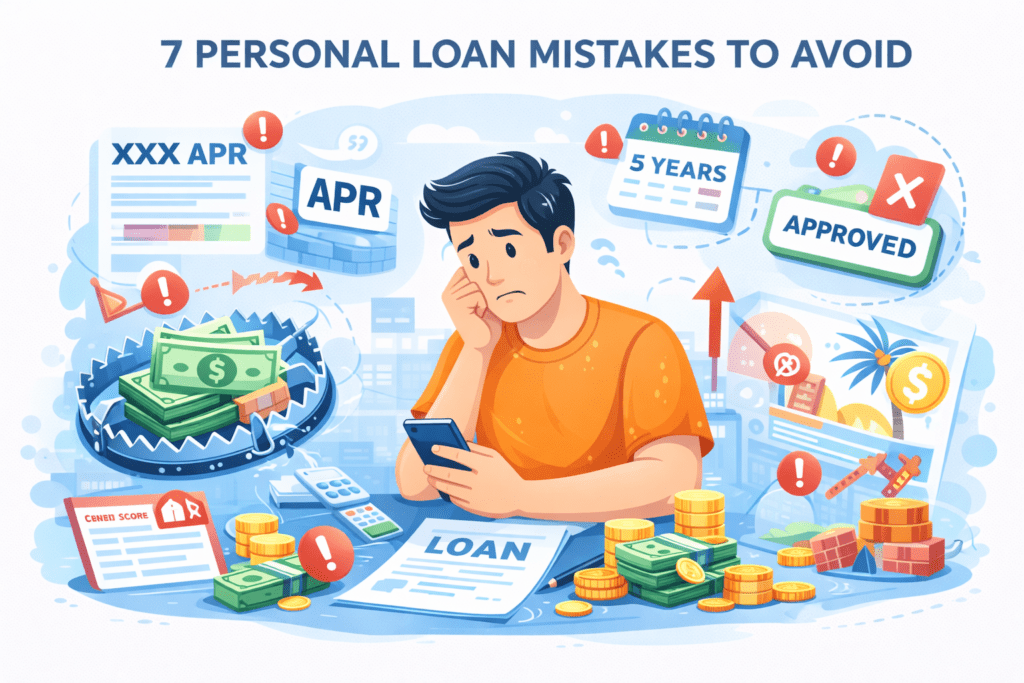
Taking a personal loan isn’t a bad decision.
But taking the wrong personal loan — or taking one the wrong way — can quietly drain your finances for years.
The truth? Most people don’t lose money because of “bad luck.”
They lose money because they don’t fully understand what they’re signing.
Before you apply for any loan in 2026, read this carefully.
1. Focusing Only on the Monthly Payment
This is the most common trap.
A lender says:
“Only $185 per month.”
Sounds affordable, right?
But what most borrowers don’t calculate is the total repayment amount over the full term.
A $10,000 loan at high interest over 5 years can turn into $14,000–$16,000 total repayment.
Always ask:
- What’s the APR?
- What’s the total repayment amount?
- Are there fees included?
Monthly payments can be manipulated. Total cost can’t.
2. Ignoring the APR (Not Just the Interest Rate)
Interest rate and APR are not the same.
APR includes:
- Origination fees
- Processing costs
- Mandatory charges
A loan with 8% interest but 14% APR is not a cheap loan.
If you compare loans, compare APR — not just advertised rates.
3. Borrowing More Than You Actually Need
It’s tempting.
You apply for $8,000.
The lender approves $15,000.
And suddenly you think:
“Maybe I’ll take the extra.”
That “extra” money is not free.
You’ll pay interest on every dollar.
Borrow what solves the problem — nothing more.
4. Choosing the Longest Term to Lower Payments
Lower monthly payments feel safer.
But longer terms mean:
- More total interest paid
- Longer debt obligation
- Slower financial recovery
A 3-year loan may feel heavier monthly — but it can save thousands compared to a 6-year term.
Shorter term = less total cost (if affordable).
5. Not Checking for Prepayment Penalties
Some lenders charge fees if you repay early.
Yes, you read that correctly.
If your financial situation improves and you want to clear the debt faster, you could be penalized.
Always check:
“Is there a prepayment penalty?”
If yes, reconsider.
6. Using a Personal Loan for Depreciating Purchases
Using loans for:
- Vacations
- Luxury gadgets
- Non-essential upgrades
Creates a double loss:
You lose money to depreciation and interest.
Loans should ideally:
- Consolidate high-interest debt
- Cover emergencies
- Fund something that improves income potential
If the purchase doesn’t improve your financial future, rethink it.
7. Applying to Too Many Lenders at Once
Every hard inquiry can impact your credit score.
Multiple applications in a short period can:
- Lower your score
- Make you look risky
- Reduce approval chances
Instead:
- Pre-check eligibility (soft checks)
- Compare lenders strategically
- Apply selectively
When Is a Personal Loan Actually Smart?
A personal loan can be powerful when used correctly.
It makes sense when:
- Consolidating credit card debt (lower APR)
- Handling emergency expenses
- Covering necessary medical bills
- Financing something with long-term value
The problem isn’t the loan.
It’s the lack of strategy.
Final Thoughts
Debt isn’t evil.
But unmanaged debt is expensive.
Before signing anything:
- Understand the total cost
- Compare APR, not hype
- Borrow intentionally
- Plan your repayment strategy
A personal loan should solve a problem — not create a new one.
Make it a tool. Not a trap.
SpinTimeApp, huh? An app specifically for slots? I’m intrigued! If it’s smooth, lag-free, and has a good selection of games, I’m sold. Let’s see if you can make my downtime a bit more exciting. Worth a download to find out spintimeapp.