
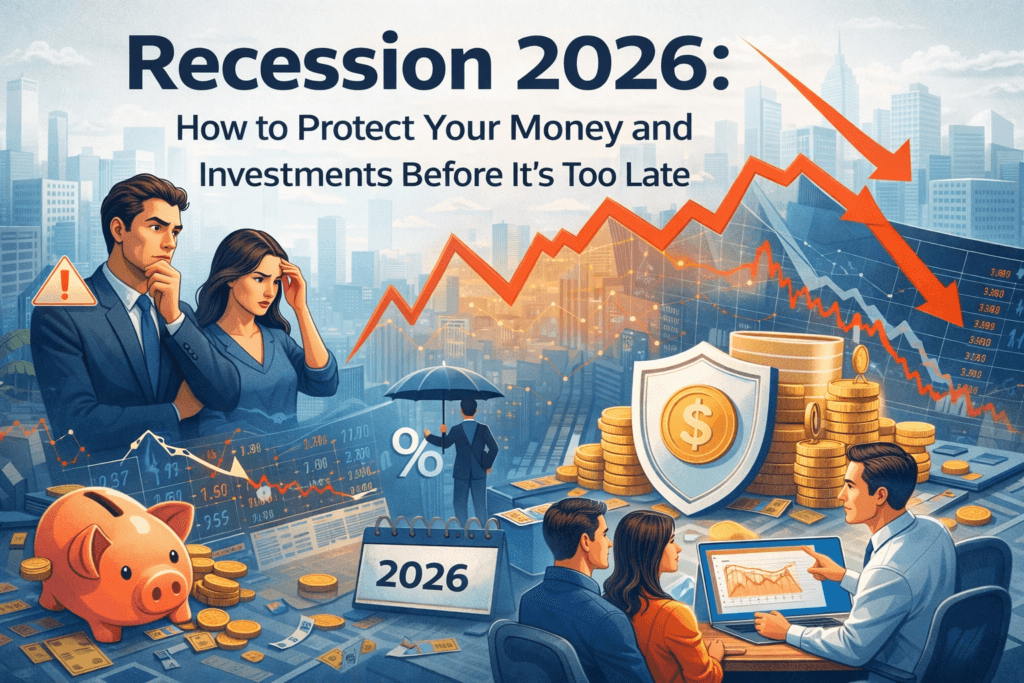
The word recession changes behavior. It shifts spending habits, freezes hiring decisions, and makes investors question everything. Whether the slowdown in 2026 turns mild or severe, one truth remains consistent: people who prepare early preserve wealth, while those who react late often protect what’s left.
If you’re searching for how to protect your money during a recession, you are not alone. Search data always spikes when economic uncertainty rises. But instead of reacting emotionally, the smarter move is to understand how downturns work — and how disciplined positioning can turn volatility into opportunity.
Understanding What a Recession Really Means
A recession is not simply “the market going down.” It typically reflects contracting economic activity: slowing GDP growth, rising unemployment, tighter credit conditions, and weaker consumer demand. Markets anticipate these conditions before headlines confirm them.
By the time fear dominates mainstream media, institutional investors have often already repositioned portfolios. That’s why preparation matters more than prediction.
Step 1: Strengthen Your Financial Foundation
Before thinking about investing strategy, protect your base.
Build or reinforce your emergency fund.
Liquidity equals flexibility. In uncertain times, cash is not weakness — it is optionality. Ideally, maintain 6–12 months of essential expenses in accessible, low-risk accounts.
Reduce high-interest debt.
During recessions, interest burdens feel heavier. Paying down variable-rate debt creates guaranteed “returns” equal to the interest you eliminate.
These moves may not sound exciting, but they are foundational. Wealth preservation begins with stability.
Step 2: Rebalance Toward Defensive Assets
Certain asset classes historically perform more resiliently during downturns.
Defensive stocks such as utilities, healthcare, and consumer staples often experience steadier demand.
High-quality bonds may provide income stability if interest rates decline.
Gold and hard assets sometimes attract capital when uncertainty rises.
Diversification is not about eliminating risk — it is about preventing concentration risk. A portfolio overly exposed to speculative growth sectors can experience amplified drawdowns.
Step 3: Avoid Emotional Selling
One of the costliest mistakes investors make during recessions is panic selling near market bottoms. Markets are forward-looking. When economic data looks worst, markets may already be pricing recovery.
History repeatedly shows that missing just a handful of the strongest rebound days can drastically reduce long-term returns. Instead of reacting to headlines, use predetermined allocation rules and rebalance methodically.
Step 4: Look for Strategic Opportunities
Recessions also create asymmetry.
Strong companies with healthy balance sheets often trade at discounted valuations. Investors with liquidity can gradually accumulate high-quality assets at lower prices.
Dollar-cost averaging becomes powerful during volatility. Rather than attempting to time the exact bottom, systematic investing reduces emotional pressure while capturing long-term upside.
Step 5: Monitor Risk, Not Noise
Modern investors have access to advanced analytics tools, portfolio stress tests, and macro indicators. Focus on measurable signals:
- Corporate earnings trends
- Credit spreads
- Employment data
- Central bank policy shifts
Avoid overconsuming sensational media narratives. Information overload often amplifies fear without improving decision quality.
The Bigger Picture: Mindset Over Timing
Recessions are cyclical, not permanent. Every contraction in modern history has eventually been followed by recovery. The investors who emerge stronger are typically those who:
- Maintain liquidity
- Control debt
- Diversify intelligently
- Stay disciplined
Protection does not mean abandoning growth. It means positioning capital so you can survive turbulence and participate in recovery.
Recession 2026 may test confidence, but it also offers clarity. Financial resilience is built before crisis peaks, not during it. The real question is not whether a downturn will come — cycles are inevitable. The real question is whether your strategy is built to endure it.
Preparation is not fear. It is strategy.