
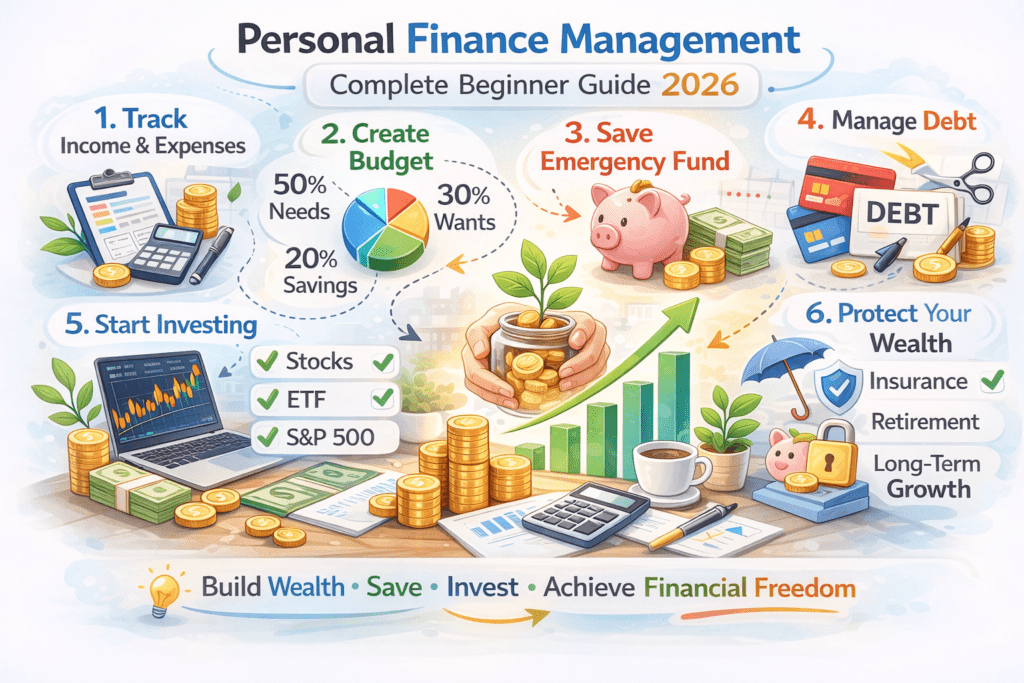
If you want better control over your money, mastering personal finance management is the first step.
Most people don’t struggle because they earn too little.
They struggle because they don’t have a clear system.
Money without structure disappears.
But money with direction builds freedom.
Let’s build that structure step by step — in simple language.
What Is Personal Finance Management?
Personal finance management means organizing how you:
- Earn money
- Spend money
- Save money
- Invest money
- Protect money
It’s not about being rich.
It’s about being intentional.
When you manage money properly, stress decreases and confidence increases.
Step 1: Understand Where Your Money Goes
Before improving anything, you need clarity.
Track:
- Monthly income
- Fixed expenses (rent, insurance, utilities)
- Variable expenses (food, entertainment)
- Debt payments
- Savings
Most people are surprised when they see how much small daily spending adds up.
Awareness creates control.
Step 2: Build a Simple Budget That Actually Works
A budget is not punishment. It’s permission.
One simple method:
50% Needs
30% Wants
20% Savings & Investing
This framework helps beginners avoid overcomplicating money decisions.
If 20% feels too high, start with 10%. The key is consistency.
Step 3: Create an Emergency Fund
Before investing aggressively, build security.
Financial experts typically recommend saving 3–6 months of expenses.
Why?
Because emergencies happen:
- Job loss
- Medical expenses
- Unexpected repairs
Without emergency savings, people rely on high-interest debt.
And debt destroys financial progress.
Step 4: Eliminate High-Interest Debt
Not all debt is equal.
Credit card debt with high interest rates can quietly drain your finances.
Prioritize:
- Paying off high-interest balances first
- Avoiding minimum payments only
- Stopping new unnecessary debt
Reducing debt increases your financial breathing room.
Step 5: Start Growing Your Money
Once your foundation is stable, growth becomes the focus.
This is where investing comes in.
Many beginners start with diversified funds tracking the S&P 500 because they offer exposure to many companies at once.
Over long periods, disciplined investing has historically rewarded patience.
Personal finance management is not only about saving — it’s about growing.
Step 6: Protect What You Build
Wealth building isn’t complete without protection.
Consider:
- Health insurance
- Life insurance (if you have dependents)
- Disability coverage
Protection prevents one unexpected event from resetting years of progress.
The Psychology of Money
Managing money isn’t only mathematical — it’s behavioral.
People often:
- Spend emotionally
- Delay saving
- Compare themselves to others
Strong personal finance management requires discipline and long-term thinking.
Small smart decisions repeated over years create massive results.
Common Personal Finance Mistakes
Avoid these:
- Living paycheck to paycheck without tracking
- Ignoring retirement planning
- Delaying investing too long
- Overspending to impress others
- Relying on one income source only
Financial stability is built gradually, not instantly.
A Simple Personal Finance Blueprint
If you want clarity, follow this order:
- Track expenses
- Build budget
- Save emergency fund
- Eliminate high-interest debt
- Invest consistently
- Protect with insurance
Simple. Structured. Sustainable.
Final Thoughts
Personal finance management is not about complexity.
It’s about control.
When you control your money, you reduce stress.
When you reduce stress, you make better decisions.
When you make better decisions, wealth becomes predictable.
Financial freedom is rarely about luck.
It’s about structure + discipline + time.