
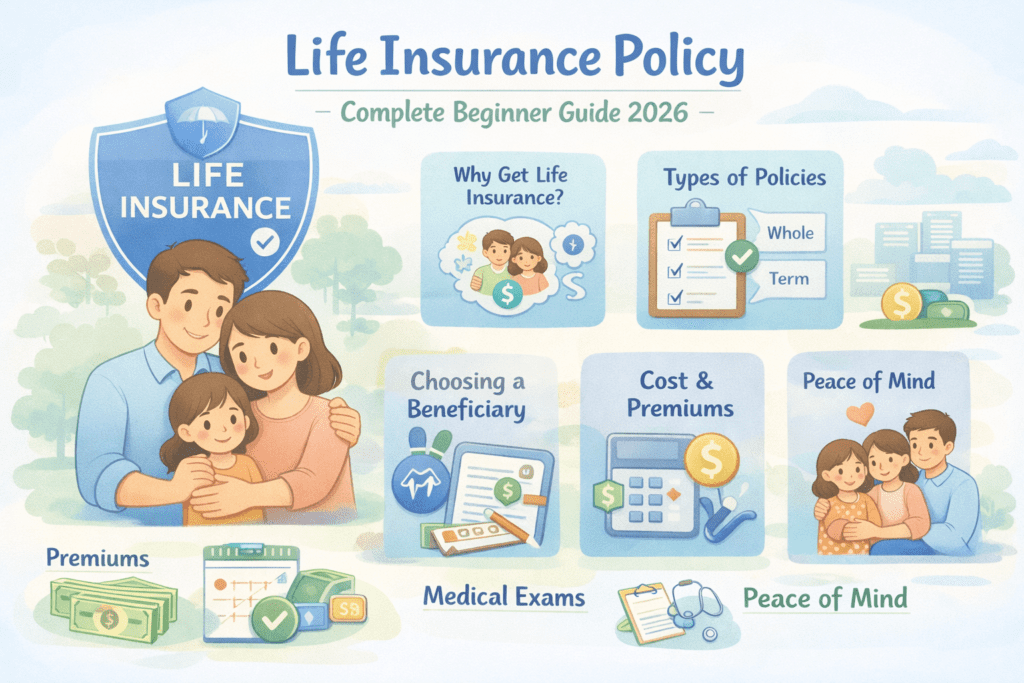
No one likes thinking about worst-case scenarios.(life insurance policy)
But financial protection is not about fear.
It’s about responsibility.
A life insurance policy ensures that if something happens to you, your family will not struggle financially.
It replaces income.
It covers debt.
It protects long-term plans.
Let’s break it down simply.
What Is a Life Insurance Policy?
A life insurance policy is a contract between you and an insurance company.
You pay monthly or yearly premiums.
In return, the insurer pays a lump sum (called a death benefit) to your beneficiaries if you pass away.
That money can be used for:
- Mortgage payments
- Daily living expenses
- Education costs
- Outstanding debts
- Funeral expenses
It creates financial stability during emotional hardship.
Why Life Insurance Matters
If people depend on your income, life insurance is not optional — it’s strategic.
Without it:
- Family income may suddenly disappear
- Debt payments remain
- Children’s education plans may be disrupted
Life insurance transforms uncertainty into financial security.
Types of Life Insurance Policies
Understanding the types helps you choose wisely.
1️⃣ Term Life Insurance
Term life covers you for a specific period:
- 10 years
- 20 years
- 30 years
If you pass away during the term, your family receives the payout.
Pros:
- Lower cost
- Simple structure
- High coverage for lower premium
Best for:
Young families, income protection, mortgage coverage.
2️⃣ Whole Life Insurance
Whole life provides lifetime coverage.
It also builds cash value, which grows over time.
Pros:
- Permanent protection
- Savings component
- Stable premiums
Cons:
- More expensive
- More complex
Best for:
Long-term estate planning and wealth transfer.
3️⃣ Universal Life Insurance
Universal life offers flexibility in:
- Premium payments
- Death benefit amounts
It combines protection and investment features.
But it requires understanding of fees and performance.
How Much Coverage Do You Need?
A common rule:
10–15x your annual income.
But better calculation includes:
- Remaining mortgage balance
- Education costs
- Living expenses for 5–10 years
- Existing savings
The goal is not “maximum coverage.”
The goal is adequate protection.
How Much Does a Life Insurance Policy Cost?
Cost depends on:
- Age
- Health
- Smoking status
- Coverage amount
- Policy type
Example:
A healthy 30-year-old may pay relatively low monthly premiums for term coverage.
But waiting until 45 significantly increases costs.
In insurance, earlier usually means cheaper.
When Should You Get Life Insurance?
Consider getting coverage if:
- You have dependents
- You have a mortgage
- You are the primary income earner
- You want to protect future education costs
If no one financially depends on you, you may not need it yet.
Insurance should match responsibility.
Common Mistakes to Avoid
Avoid these:
- Waiting too long
- Buying without comparing quotes
- Choosing permanent insurance without understanding costs
- Underinsuring to save money
Cheap coverage that’s insufficient can be just as risky as no coverage.
How to Choose the Right Life Insurance Policy
Follow this framework:
- Define your financial obligations
- Calculate required coverage
- Compare multiple insurers
- Understand policy exclusions
- Review terms before signing
Insurance is a long-term commitment. Read carefully.
Is Life Insurance an Investment?
Term life is pure protection — not investment.
Whole and universal life include investment features, but often with higher fees.
If your main goal is wealth building, investing separately may be more efficient.
If your goal is protection, insurance is essential.
Know the difference.
Final Thoughts
A life insurance policy is not about expecting the worst.
It’s about preparing responsibly.
Financial planning isn’t complete without protection.
You work hard to build income and assets.
Insurance ensures they continue supporting your family — even in your absence.
Security is not pessimism.
It’s leadership.