
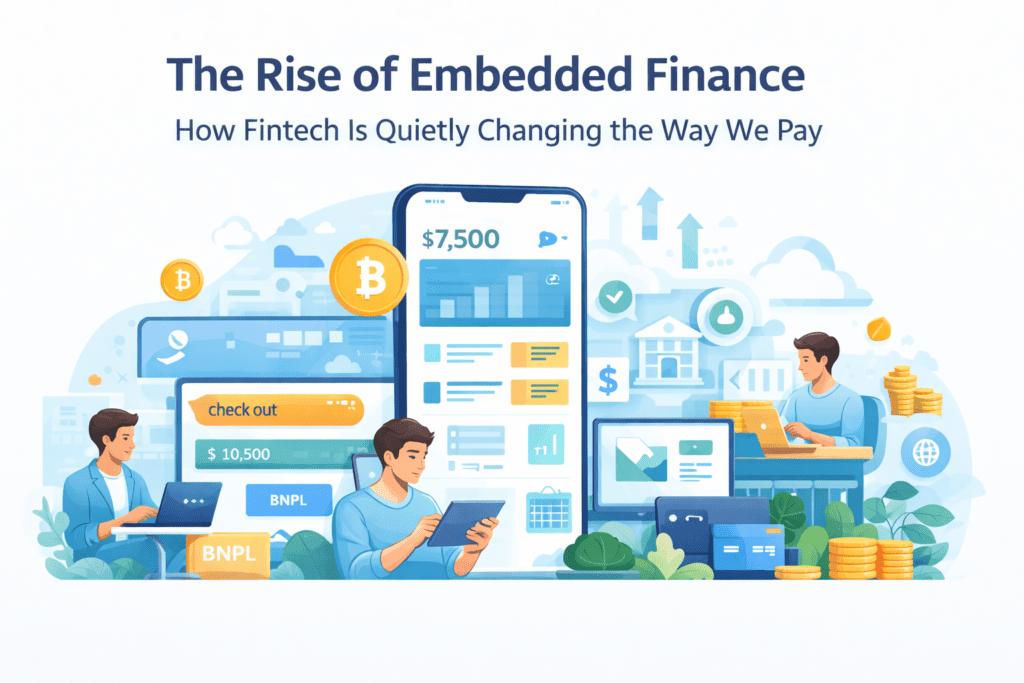
The financial industry is no longer controlled only by traditional banks. Over the past decade, fintech companies have transformed how consumers borrow, invest, save, and make payments. But one of the most powerful shifts happening today is something many users don’t even notice: embedded finance.
Embedded finance is quietly reshaping digital commerce — and it may define the next era of financial technology.
What Is Embedded Finance?
Embedded finance refers to financial services integrated directly into non-financial platforms.
Instead of going to a bank website to apply for a loan, users can now:
- Get financing directly at checkout
- Access buy-now-pay-later (BNPL) options instantly
- Open digital wallets inside apps
- Purchase insurance during an online transaction
Companies like Stripe and Square have enabled businesses to embed payments and financial tools seamlessly into digital platforms.
Consumers experience convenience. Businesses gain higher conversion rates. Financial services become invisible.
Why Embedded Finance Is Growing So Fast
Several factors are driving rapid adoption:
1. Consumer Demand for Simplicity
Modern users expect frictionless transactions. If financing is available within the checkout flow, users are more likely to complete purchases.
2. Digital-First Behavior
E-commerce growth, mobile banking, and app-based services have normalized financial interactions inside platforms.
3. API Infrastructure
Fintech infrastructure providers like Plaid make it easy to connect banking systems with apps through APIs.
This technological backbone has accelerated innovation dramatically.
The Impact on Traditional Banking
Traditional banks are facing increasing competition.
Instead of customers visiting bank branches or banking portals, financial services are now integrated into:
- E-commerce platforms
- Ride-sharing apps
- SaaS business tools
- Marketplace ecosystems
This shift reduces direct customer relationships with banks and moves financial engagement into digital ecosystems.
However, many banks are responding by partnering with fintech providers rather than competing directly.
Risks and Regulatory Challenges
Embedded finance is not without risks.
Financial services fall under strict regulations, especially in areas like:
- Consumer protection
- Data privacy
- Lending compliance
- Anti-money laundering (AML)
Regulators worldwide are paying closer attention as fintech platforms expand financial capabilities.
Because finance is considered a high-trust sector (often categorized as YMYL by Google), transparency and compliance are critical.
Opportunities for Businesses
For online businesses, embedded finance offers strategic advantages:
- Increased revenue through financing partnerships
- Higher cart completion rates
- Improved customer retention
- Cross-selling financial products
For startups, it reduces barriers to offering financial services without building full banking infrastructure.
What This Means for Consumers
For consumers, embedded finance brings:
- Faster approvals
- Seamless payments
- Broader access to credit
- Integrated financial experiences
But users should remain cautious about:
- Hidden fees
- High interest rates in BNPL services
- Data-sharing permissions
Convenience should never replace informed financial decisions.
The Future of Fintech: Invisible Finance
The next phase of fintech may not feel like fintech at all.
Finance will become increasingly invisible — integrated into every digital experience. Whether booking travel, subscribing to software, or shopping online, financial tools will operate in the background.
Embedded finance is not replacing banks.
It is redefining how financial services are delivered.
And for businesses and investors, this shift represents one of the most significant structural changes in modern financial technology.