
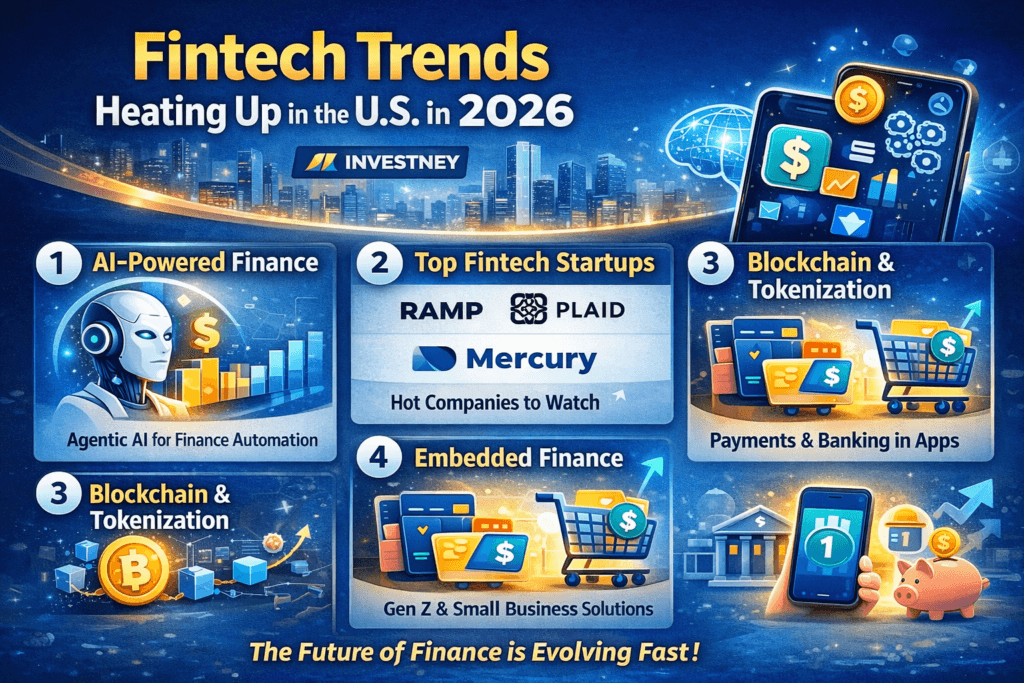
The fintech landscape in the U.S. is evolving fast in 2026, driven by AI innovation, embedded finance, blockchain‑based lending, and next‑gen banking platforms. Let’s break down what’s hot right now — and why global investors and tech watchers can’t stop talking about it.
🧠 1. AI‑Driven Fintech — The New Backbone of Financial Services
Artificial intelligence has moved beyond simple automation. Today’s fintech companies are building “agentic AI” — meaning AI that doesn’t just suggest actions but performs complex financial workflows autonomously. That includes fraud detection, customer service escalation, real‑time credit underwriting, and automated compliance.
AI is redefining the backend of finance, making processes faster, more personalized, and often cheaper for users — a major value driver for U.S. fintech adoption in 2026.
🏦 2. Fast‑Rising Fintech Players in the U.S.
Here are some of the startups shaking up the U.S. market this year:
- Ramp – A New York‑based AI‑powered corporate spend and expense platform with huge payment volume growth.
- Plaid – Still a core piece of U.S. open banking infrastructure, powering connections between banks and apps used by millions.
- Mercury – A digital banking solution for startups and businesses gaining traction.
- Mesh – Building crypto‑native payment infrastructure that integrates cross‑chain settlement.
- Rain – A growing earn‑your‑wage fintech service expanding enterprise usage.
- Lili Banking – Serves small businesses with modern online banking and credit‑building tools.
These companies are not only innovating — many are raising substantial capital and expanding user bases rapidly in the U.S. market.
💳 3. Blockchain and Tokenization Are Earning Wall Street Attention
Blockchain isn’t just for crypto anymore.
For example, Figure Technology Solutions is leveraging its own blockchain to tokenize home‑equity credit lines and facilitate peer trading — and its stock jumped over 50% since its IPO.
This move hints at a broader trend: financial products (loans, securities, stablecoins) are increasingly using distributed ledgers to cut costs and streamline transfers.
🛍️ 4. Embedded Finance Everywhere
Embedded finance — where non‑financial apps integrate payments, credit, or banking directly into their platforms — is reshaping how consumers interact with money.
Instead of opening a separate bank app, users can now:
- Make payments inside shopping apps,
- Get loans during checkout,
- Or manage financial accounts from within social and commerce platforms.
This seamless integration is becoming a standard expectation, especially in the U.S. and global markets.
👶 5. New Fintech Audiences — Youth, Small Business & Beyond
Fintech isn’t just for seasoned investors or enterprises:
- Teen finance apps, like Step (recently acquired by MrBeast’s company), are targeting Gen Z with savings tools and credit‑building features.
- Small business–focused platforms like Lili Banking are redefining banking for SMBs with modern online tools.
These segments signal fintech’s expansion into diverse user groups — making financial services more inclusive and mainstream.
📊 Final Thought: The Fintech Revolution Isn’t Slowing Down
Even with economic headwinds and capital market pressure, fintech innovation in the U.S. continues to accelerate in 2026 — from AI‑enabled services to blockchain lending and embedded financial experiences mainstreamed across industries.
Stay tuned: the next wave of fintech might not just reshape banking — it could relearn how money interacts with our daily digital lives.