
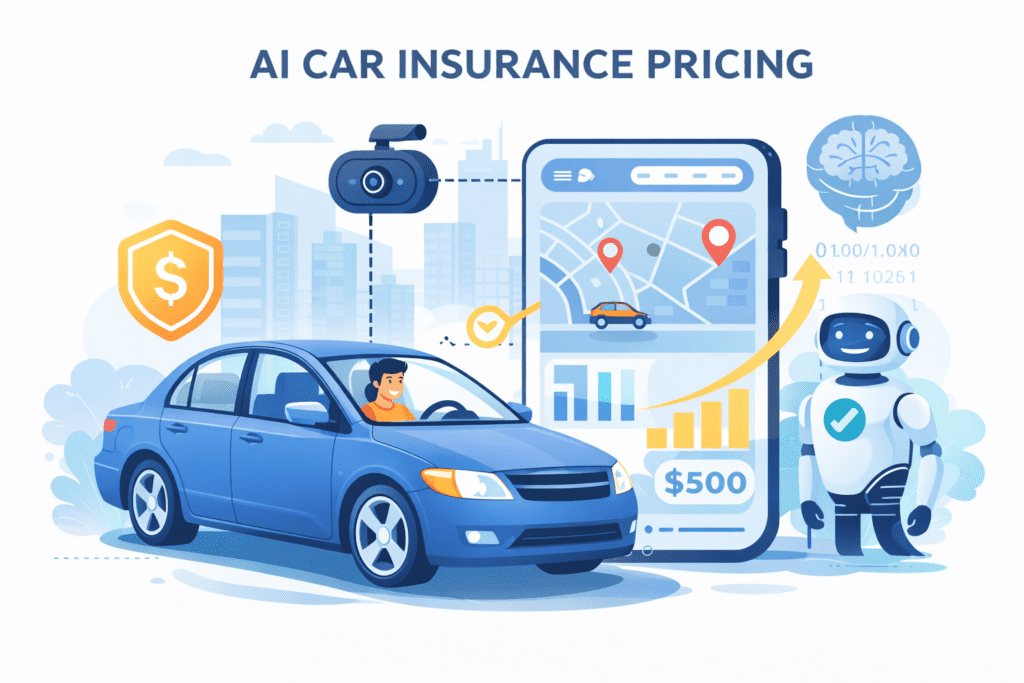
AI Car Insurance Pricing: For decades, car insurance companies calculated premiums using basic factors: age, location, vehicle type, and accident history. But in 2026, that model is rapidly changing.
Welcome to the era of AI car insurance pricing, where your premium is no longer based on broad assumptions — but on how you actually drive.
If you’re new to car insurance or looking to lower your premium, understanding how artificial intelligence and telematics work could save you hundreds of dollars per year.
What Is AI Car Insurance Pricing?
AI car insurance pricing uses machine learning algorithms to analyze real-time driving data instead of relying only on traditional risk categories.
Instead of asking:
- How old are you?
- Where do you live?
- What car do you drive?
Insurers now also ask:
- How fast do you accelerate?
- How hard do you brake?
- How often do you drive at night?
- How many miles do you drive weekly?
This data is collected through telematics devices or mobile apps installed on your phone.
How Telematics Changes Your Insurance Premium
Telematics tracks driving behavior such as:
- Speed consistency
- Sudden braking
- Sharp turns
- Mileage
- Driving time
AI systems then evaluate risk more precisely.
For example:
A 22-year-old driver used to automatically pay high premiums.
With AI pricing, if that driver demonstrates safe driving habits for 3–6 months, premiums may decrease significantly.
This creates a more personalized insurance model.
Why Insurance Companies Are Adopting AI
There are three major reasons:
1️⃣ More Accurate Risk Assessment
AI reduces guesswork. Insurers can price policies more fairly.
2️⃣ Lower Fraud Rates
Advanced algorithms detect unusual claim patterns faster than human review teams.
3️⃣ Competitive Market Pressure
Insurance is highly competitive. Companies that use AI can offer better rates to safe drivers.
Who Benefits Most From AI Car Insurance?
AI-based pricing tends to benefit:
- Low-mileage drivers
- Remote workers
- Safe drivers with clean habits
- Drivers who avoid late-night driving
However, aggressive drivers or high-mileage commuters may see little benefit.
Potential Downsides You Should Know
While AI pricing sounds attractive, there are trade-offs:
- Privacy concerns (constant data monitoring)
- Data sharing with third parties
- Penalties for occasional harsh driving
- Battery drain from telematics apps
Before opting in, always review the insurer’s data policy.
Is AI Car Insurance Pricing Worth It in 2026?
If you are confident in your driving habits, AI-based policies can reduce premiums by 10–40%.
But if you prefer privacy and predictable pricing, traditional policies may still suit you better.
The future of insurance is shifting from generalized risk pools to individualized scoring. That means safer drivers are rewarded — and risky habits cost more.
Final Thoughts
AI car insurance pricing is no longer experimental — it’s becoming standard practice worldwide.
Understanding how telematics and AI evaluate your driving behavior gives you a financial advantage. Instead of fearing the technology, smart drivers are using it to lower their costs.
Before choosing your next policy, compare:
- Traditional fixed premium
- Usage-based insurance (UBI)
- AI telematics-based pricing
In 2026, the smartest way to save on car insurance may not be switching companies — but improving how you drive.